
Your biorhythm chart, in plain words.
Enter your birth date once and see today's physical, emotional and intellectual rhythms as three clear curves, each with two short sentences and one small tip. Then log how you actually felt and judge for yourself whether it fits.
Biorhythms are a traditional calculation, not a scientific prediction or medical advice. Use Trisine for reflection and fun, and plan your day your own way.
Get it on Google Play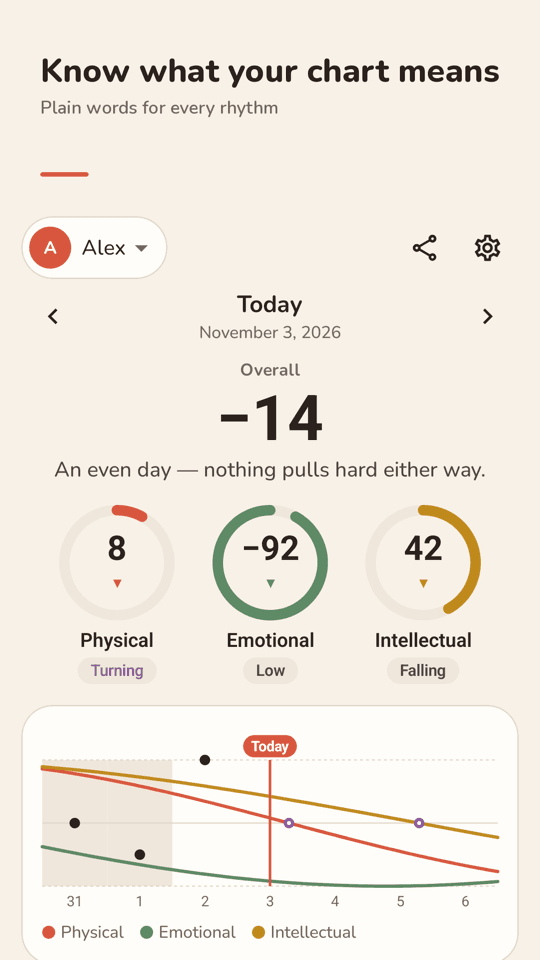
Today at a glance
Three ring gauges for physical, emotional and intellectual, plus an overall score from -100 to +100.
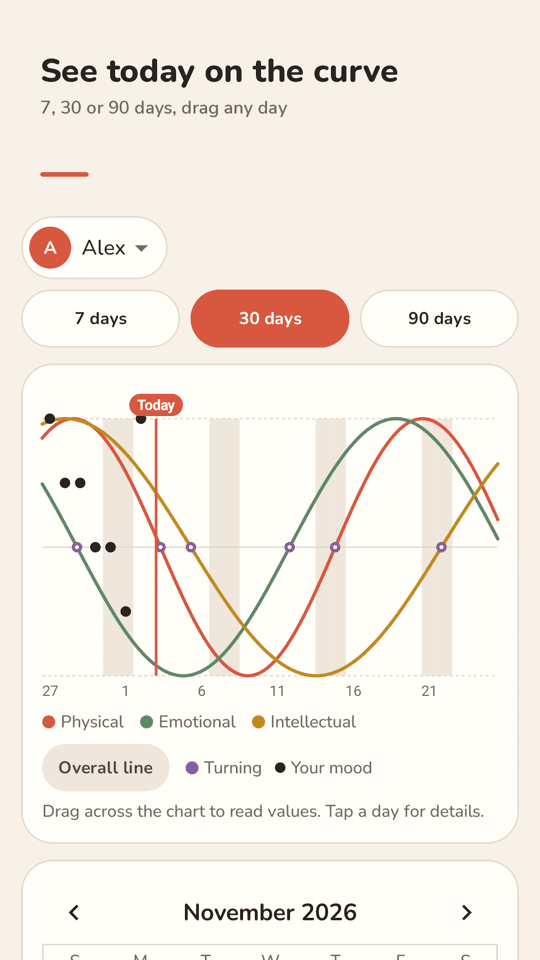
A chart with today marked
A vertical line shows where you are. Switch between 7, 30 and 90 days and drag to see any day.
Notes in plain words
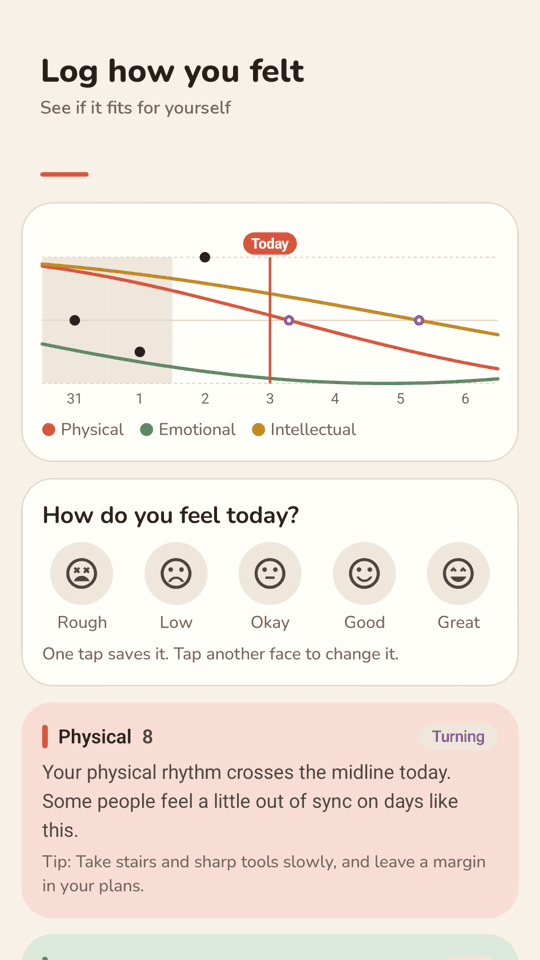
Every rhythm and phase (high, rising, turning, falling, low) gets two short sentences and one tip. No long reads.
Critical days ahead
The days a rhythm crosses zero are shown a few days early as a gentle heads-up, never gloom and doom.
Log how you felt
One tap a day. Your check-ins appear as dots on the chart, so you can see whether the curves match your real days.
Family, friends and compatibility
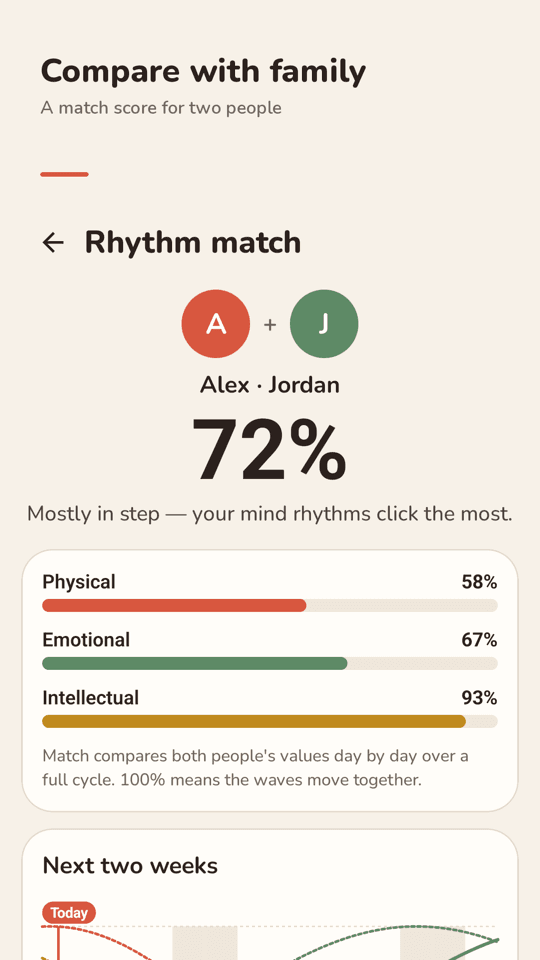
Add as many profiles as you like and compare two people's rhythms with a match score and both curves side by side.
Morning summary and widget
A morning notification with today's numbers and a home screen widget, so you don't have to open the app.
Exact birth time, no account
Add your time of birth if you know it. Profiles and check-ins stay on your phone. CSV export of your log.
FAQ
- I see the curves, but what do they mean?
- Above zero means a rhythm is in its active half, below zero its quieter half. Values near +100 or -100 are the peak and the low point. Trisine writes this out for you every day in two sentences per rhythm, so you don't have to interpret the graph yourself.
- Is a biorhythm chart accurate?
- Biorhythms are a traditional calculation from your birth date, not a scientific prediction, and studies have not shown that they predict performance or accidents. The math itself is exact: every screen, the widget and the notification show the same numbers. That is why Trisine lets you log how you felt and compare it with the curves yourself.
- What is a critical day (turning day)?
- A critical day is a day when one of the rhythms crosses the zero line, switching between its active and quiet half. Trisine marks these days on the chart and lists the next ones on the Today screen.
- Do I need my exact time of birth?
- No. Without it, Trisine assumes noon. If you know your birth time, adding it shifts the curves slightly and makes the day a rhythm crosses zero more precise.
- How does biorhythm compatibility work?
- Trisine compares two people's physical, emotional and intellectual curves day by day over one full cycle. Curves that move together score close to 100%, curves that move in opposite directions score around 36%. You get a score per rhythm, an overall score and both curves overlaid.
- How do I add family or friends?
- Open the People tab and tap +. Add a name and birth date, then switch between profiles from the chip at the top of the Today screen.
- Is it free? Do I need an account?
- Trisine is free and supported by ads. There is no account or sign-up, and your profiles and check-ins are stored only on your device.
- What do the three cycles mean?
- Physical repeats every 23 days, emotional every 28 days and intellectual every 33 days, all starting at zero on the day you were born.